Retention
Retention in the Analyze area (Behavior) — route /analyze/retention.
Retention lives in the Analyze area of the dashboard, under Behavior.
At a glance#
| Dashboard route | /analyze/retention |
| Area | Analyze (analyze) |
| Group | Behavior |
| Platforms | Available for every app platform. |
What it does#
Retention reports DAU, WAU and MAU alongside a weekly first-seen cohort retention grid: each row is the users who first appeared in a given week, and the columns show how many came back in each week after.
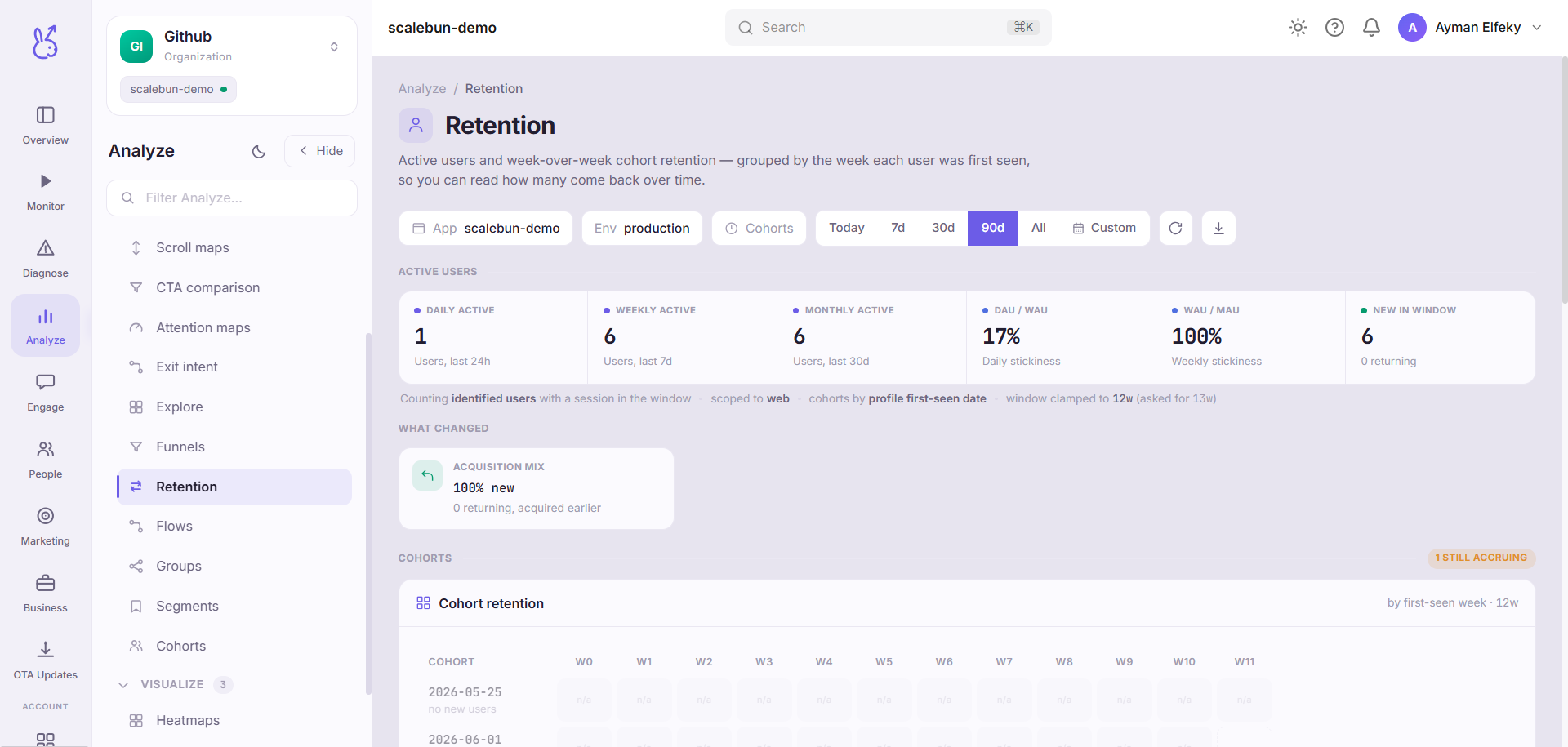
Recent cohorts are explicitly marked as still maturing rather than being shown as though their low numbers were final — which is the single most common way a retention grid gets misread.
When to use it#
As the standing health check on whether the product is worth returning to. Active-user counts can be carried by acquisition; retention cannot. If DAU is up and cohort retention is down, you are replacing users rather than keeping them.
The DAU/WAU ratio is worth watching on its own: it approximates how many days a week your users show up, and it moves for reasons that active-user totals hide.
Workflow#
Ignore the newest rows
They are incomplete by construction and marked as such. Reading them early is the classic error.
Read the first column down the page
Week-one retention by cohort. Falling as you read down means your recent cohorts are worse — an acquisition or onboarding problem, not a product-depth one.
Read a row across for the decay shape
Flattening means you have found a committed core. Still declining at week eight means you have not.
Check DAU/WAU separately
Retention says they come back. DAU/WAU says how often. A product can be strong on one and weak on the other.
Permissions and prerequisites#
Limits and edge cases#
Weekly cohorts only on this page. For a different cohorting basis see Cohorts.
"Returned" means generated an event. An app that can be used without emitting anything understates retention.
Small cohorts are volatile. Check the cohort size before reacting to a percentage.
A cohort's row never changes retroactively — that is what makes cohorts comparable and single-period metrics not.
Troubleshooting#
Retention looks catastrophic. Check identify before anything else. Unlinked identity is the cause far more often than the product is.
A single cohort is an outlier. Look for a campaign or a launch that week. Acquisition source explains almost every outlier row.
Where the data comes from#
From the SDK
Served by
Analytics
Cohorts