User properties
User properties in the People area (Identity) — route /people/user-properties.
User properties lives in the People area of the dashboard, under Identity.
At a glance#
| Dashboard route | /people/user-properties |
| Area | People (people) |
| Group | Identity |
| Platforms | Available for every app platform. |
What it does#
User properties lists every property that has been detected on your users — discovered from identify calls and from events, not declared in advance. For each one you can see that it exists and how it has been arriving.
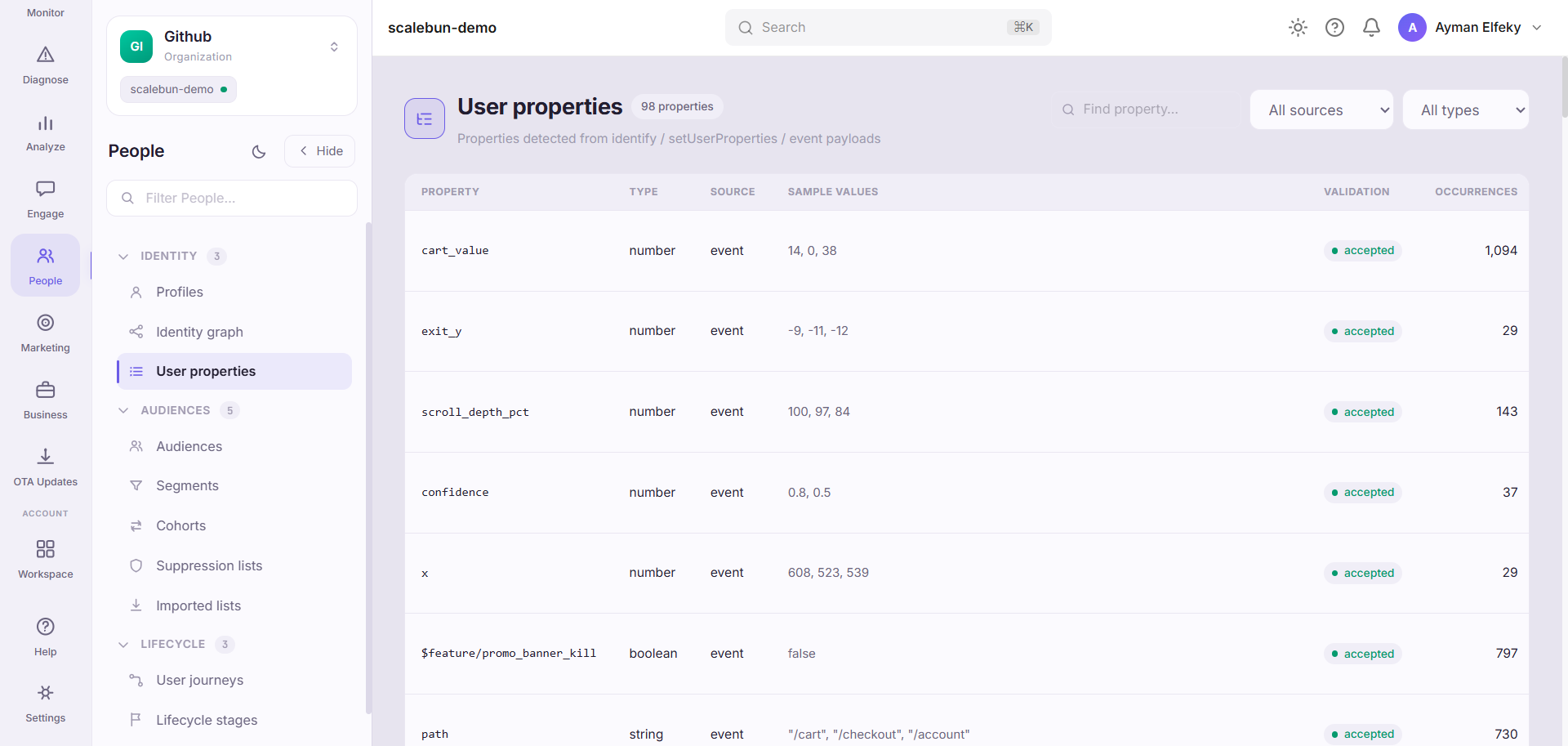
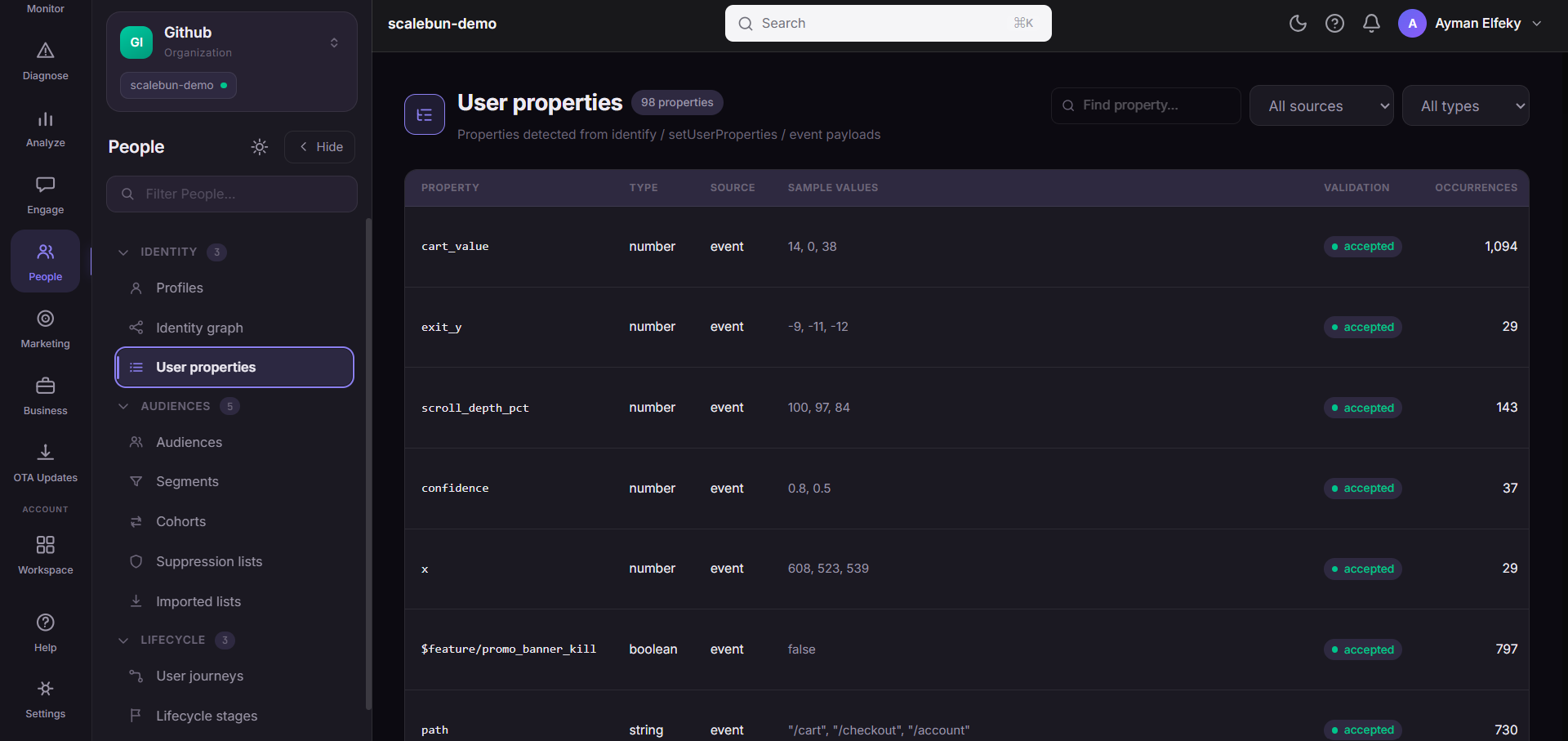
This is the schema you actually have, as opposed to the one you intended. The difference between those two is where most segmentation bugs live.
When to use it#
Before you build a segment, and after any instrumentation change. A segment that filters on a property name you mistyped matches nobody and reports no error — checking the real property list first is the cheapest possible way to avoid that.
Also as a periodic audit. Property lists accumulate: variants, typos, abandoned experiments.
Workflow#
Look for near-duplicate names
plan,planName,plan_nameandPlanare four properties as far as any query is concerned. Consolidating them is worth doing before you build anything on top.Check for inconsistent types
The same property arriving sometimes as a string and sometimes as a number will behave unpredictably in comparisons. SDK Health also flags mixed-type payloads.
Watch cardinality
A property with an unbounded value space — a timestamp, a session id, a full URL — is not useful for segmentation and is expensive to carry. Those belong on events, not on the user.
Permissions and prerequisites#
Requires event ingestion. Properties appear as they arrive; nothing needs registering.
Limits and edge cases#
Discovered, not declared. There is no schema to enforce here, which is what makes typos silent. Consistency has to come from your own code.
A property is not removed by stopping sending it. It remains listed with its historical values.
Personal data can end up here. Whatever you attach to a user is stored, so decide deliberately what belongs on a profile.
Troubleshooting#
A property I send is not listed. Confirm it is on the identify call or the event you think it is, and that it is not nested inside another object under a different key.
Two spellings of the same property. Pick one in code, and treat the other as legacy — you cannot rename it retroactively here.
Where the data comes from#
From the SDK
Served by
People / CDP