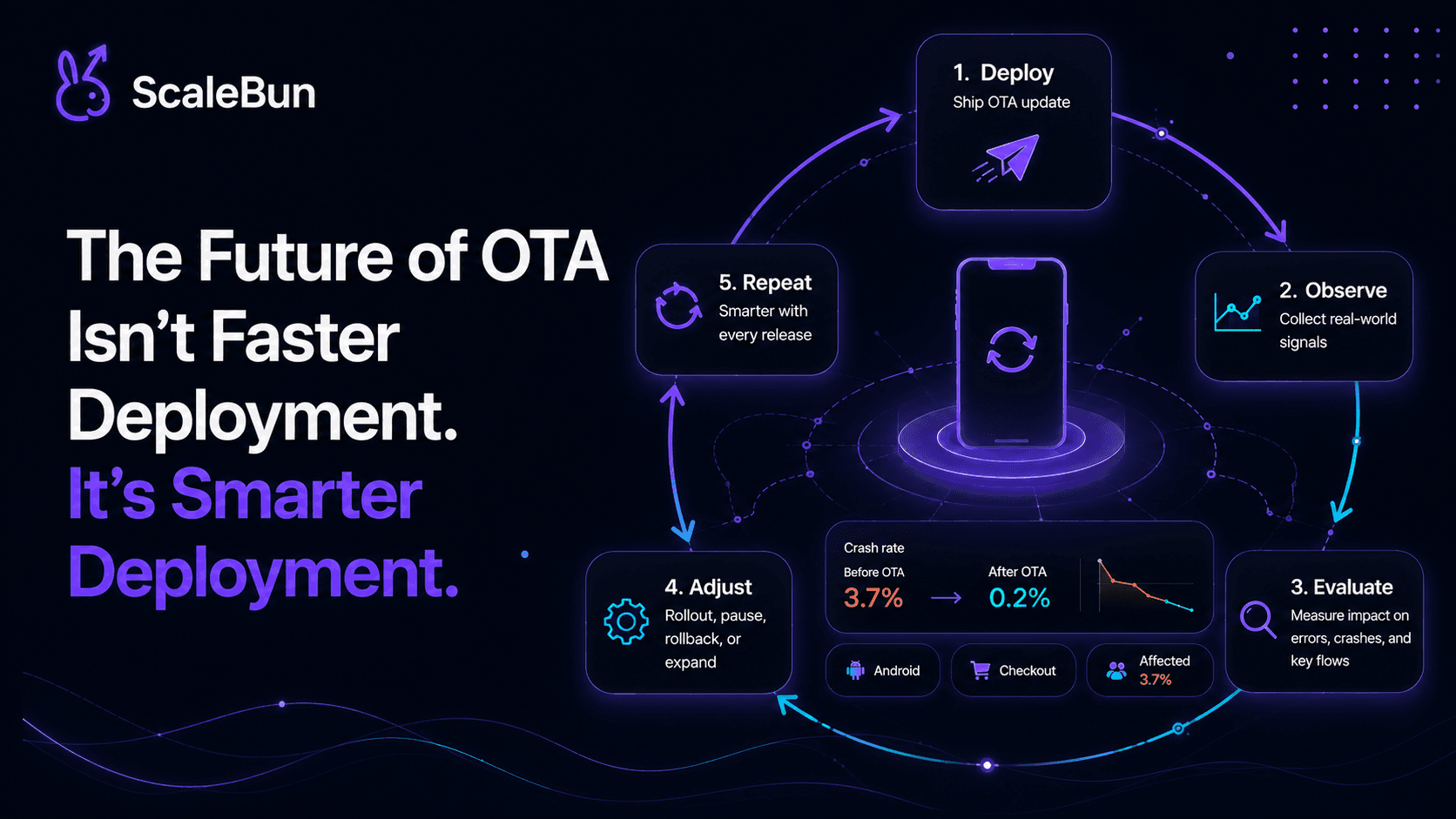
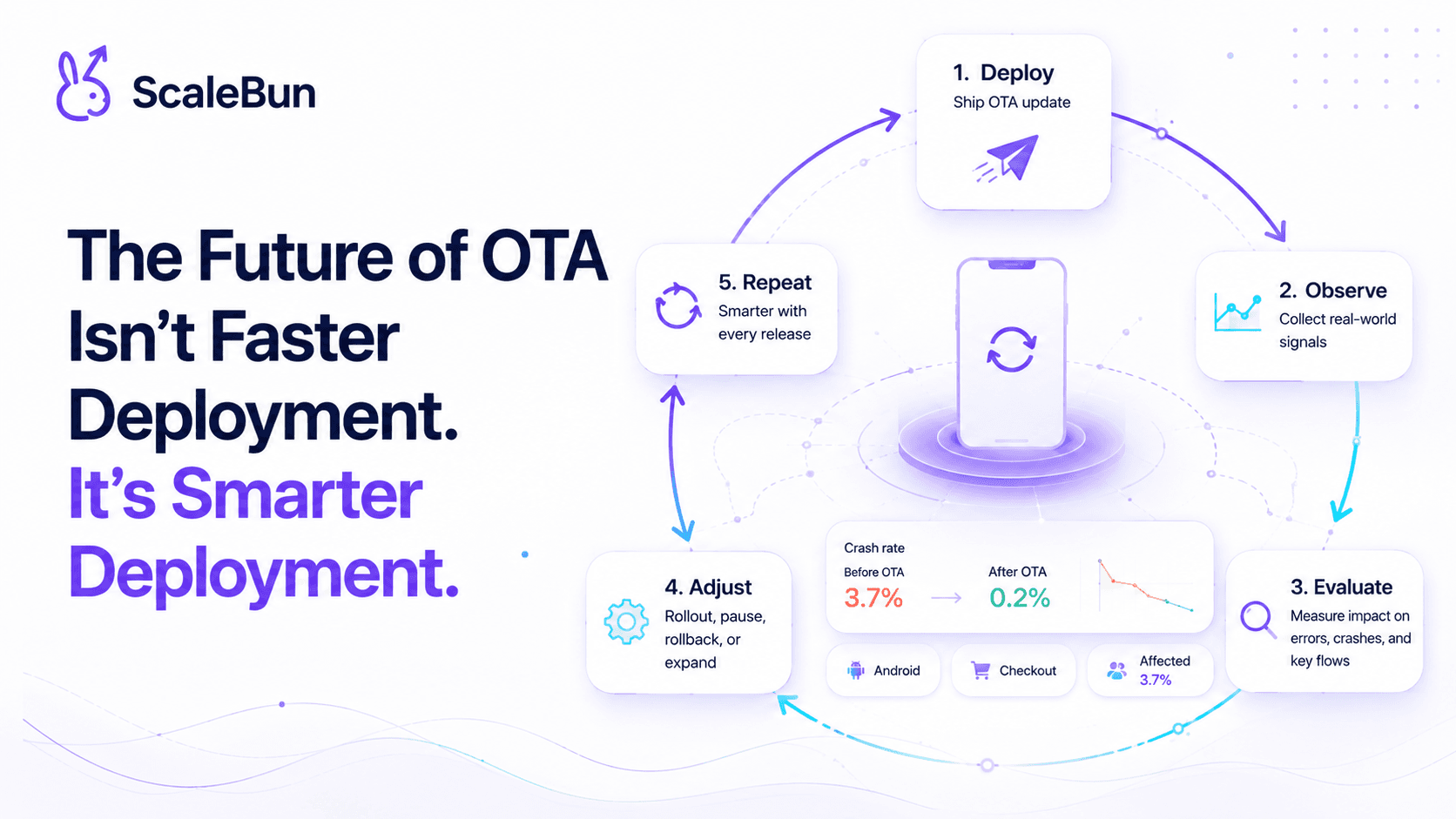
Most OTA tools answer this question:
“How do I ship JavaScript without publishing another app version?”
Useful.
But not particularly ambitious.
The more interesting question is:
How do I know whether the update I just shipped actually fixed the problem?
That requires connecting deployment data with production behavior.
ScaleBun is in an unusual position here because its SDK isn't only distributing updates.
It can also observe application sessions, errors, behavior, devices, and releases.
That creates the ingredients for something more interesting than traditional OTA.
Imagine an update with a feedback loop#
A checkout crash appears.
ScaleBun identifies:
Error introduced: release 4.8.1Affected users: 3.7%Primary environment: AndroidCommon journey: checkoutEngineer fixes it.
OTA package goes out gradually.
Now compare:
Before OTACrash rate: 3.7%
After OTACrash rate: 0.2%
The deployment system didn't merely send code.
It validated the outcome.
That's a major difference.
Eventually rollouts can become risk-aware#
Take this idea further.
A platform with enough context could decide:
Start with 5%.
Watch error rate.
Watch crashes.
Watch performance.
Watch key flows.
If health remains stable, move to 20%.
Then 50%.
Then 100%.
If something goes wrong?
Stop rollout.
Potentially roll back.
This is common thinking in backend deployment infrastructure.
Mobile OTA has historically been more primitive.
Which is strange when you consider that mobile releases can be harder to recover from.
The really interesting future isn't OTA.
It's closed-loop mobile deployment.
Deploy.
Observe.
Evaluate.
Adjust.
That starts looking less like CodePush and more like a production control plane.
Verify a rollout, don't just ship it
See how ScaleBun connects OTA rollouts to the crash and error data that proves they worked.
See OTA updates→