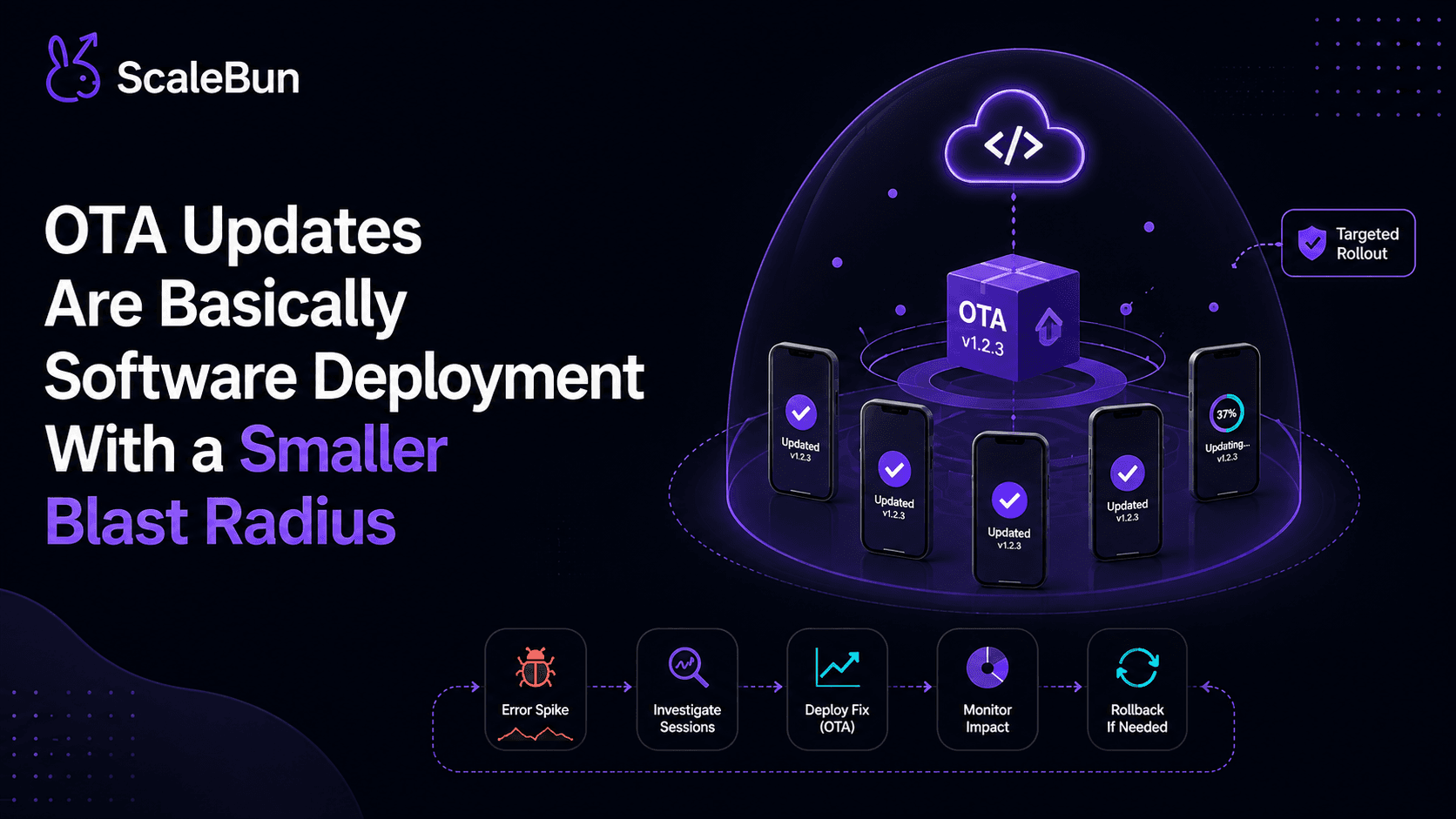
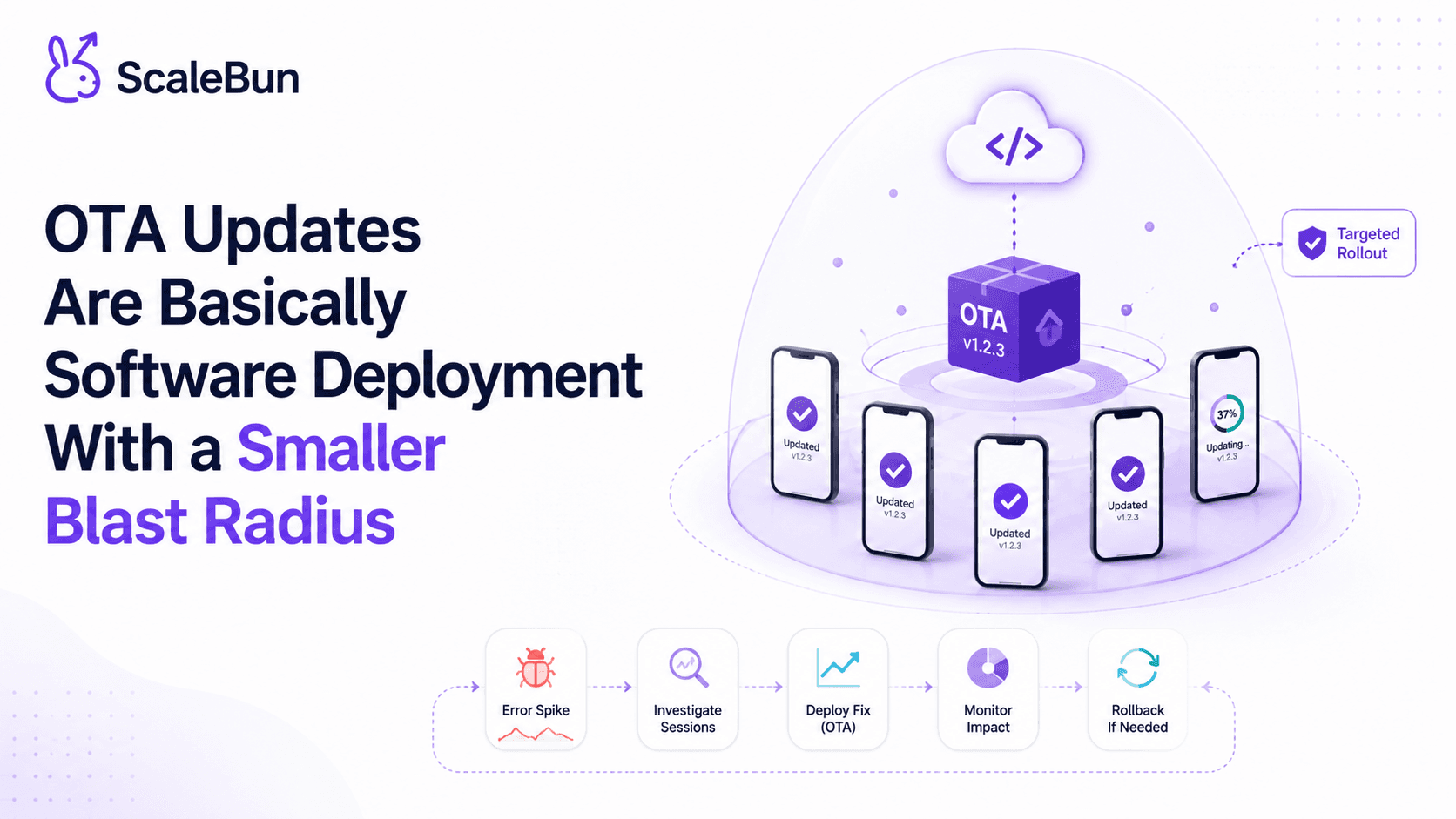
Mobile releases have an unusual problem.
On the web, fixing a typo looks like this:
deployMobile looks more like:
Build application.
Upload application.
Wait.
Review.
Release.
Hope users update.
Discover half of them haven't.
Contemplate career choices.
That's one reason over-the-air updates exist.
For React Native apps, a large portion of application behavior lives inside JavaScript bundles and assets.
If you can safely deliver those resources independently of the native binary, certain fixes don't require another App Store or Play Store release.
ScaleBun provides OTA updates for React Native.
But OTA sounds simpler than it really is.
You're shipping production code remotely#
That's powerful.
It also means you need actual deployment discipline.
An OTA platform should make teams think about things like:
deployment targeting
compatibility
rollout control
version awareness
monitoring
rollback
release history
Because pushing JavaScript directly into production devices without guardrails is essentially:
git push --forceexcept customers are involved.
OTA is really about recovery speed#
The most obvious use case is emergency fixes.
Imagine a JavaScript bug breaks a checkout flow.
Without OTA:
fix → build → store review → release → user adoption.
With OTA:
fix → deploy compatible bundle → users receive update.
That difference can be enormous for applications where downtime translates directly into lost transactions.
But faster deployment alone isn't the interesting part.
The interesting part is what happens when OTA becomes connected to observability.
If your platform knows:
which sessions are failing,
which release users are running,
which errors increased,
and which OTA package was deployed,
then deployment becomes much more intelligent.
Now we're getting somewhere.
Ship OTA updates with real deployment controls
See how ScaleBun handles targeting, rollout control, and rollback for React Native OTA.
See OTA updates→