There are few sentences engineers fear more than:
“Something has been broken for a while.”
How long?
Nobody knows.
Which release?
Nobody knows.
Did yesterday's deployment cause it?
Maybe.
Wonderful.
This is why release metadata matters far more than it sounds.
Before-and-after beats a guess#
Say we deploy at 2 PM.
Beforecheckout conversion: 8.1%frontend error rate: 0.6%payment failures: ~1%
Aftercheckout conversion: 6.8%frontend error rate: 1.9%payment failures: 4%
That doesn't prove the release caused the problem, but it gives you a pretty good place to start.
Bugs need history#
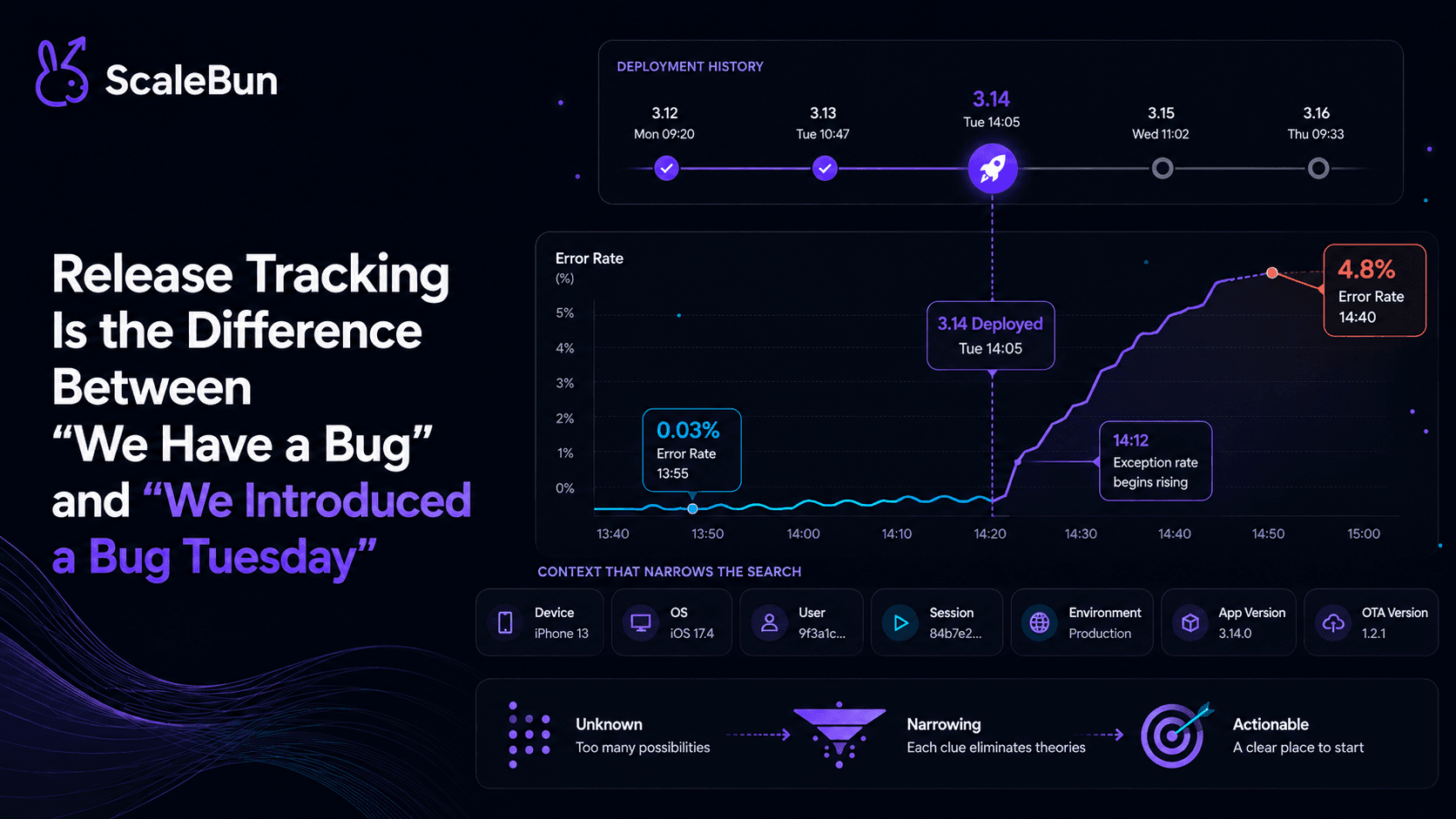
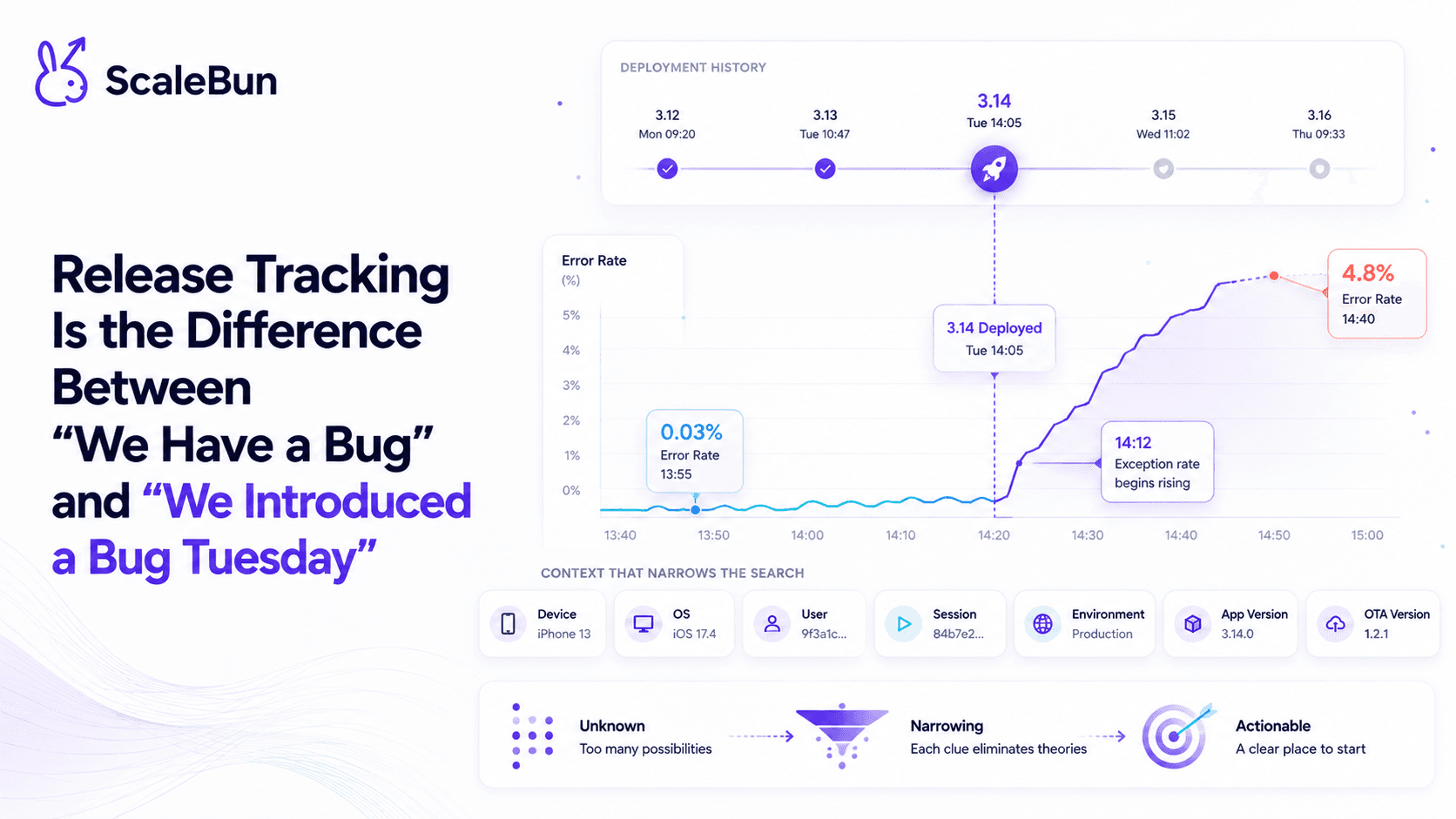
Imagine an exception suddenly rises from:
0.03% → 4.8%Interesting.
Now overlay deployment history.
14:05 — Release 3.14 deployed14:12 — exception begins risingSuddenly we have a suspect.
Correlation isn't proof, but it's an excellent place to start looking.
ScaleBun connects application behavior with release and OTA information so teams can understand what users were actually running when something happened.
That sounds boring.
It isn't.
Production debugging is largely an exercise in narrowing possibility space.
Every useful piece of context eliminates theories.
Device.
OS.
User.
Session.
Environment.
Application version.
OTA version.
Eventually the list of possibilities gets small enough that someone can fix the thing.
That's basically debugging.
Scientific method, except your laboratory occasionally has push notifications.
Know which release introduced the bug
ScaleBun connects error and crash data to release history automatically.
See releases & rollouts→