Product analytics is extremely good at answering questions like:
How many users reached checkout?
How many activated the feature?
Where does onboarding drop off?
These questions matter.
But eventually somebody asks the dangerous follow-up:
Why?
That's where analytics dashboards often shrug.
Funnels are excellent smoke detectors#
Suppose onboarding looks like:
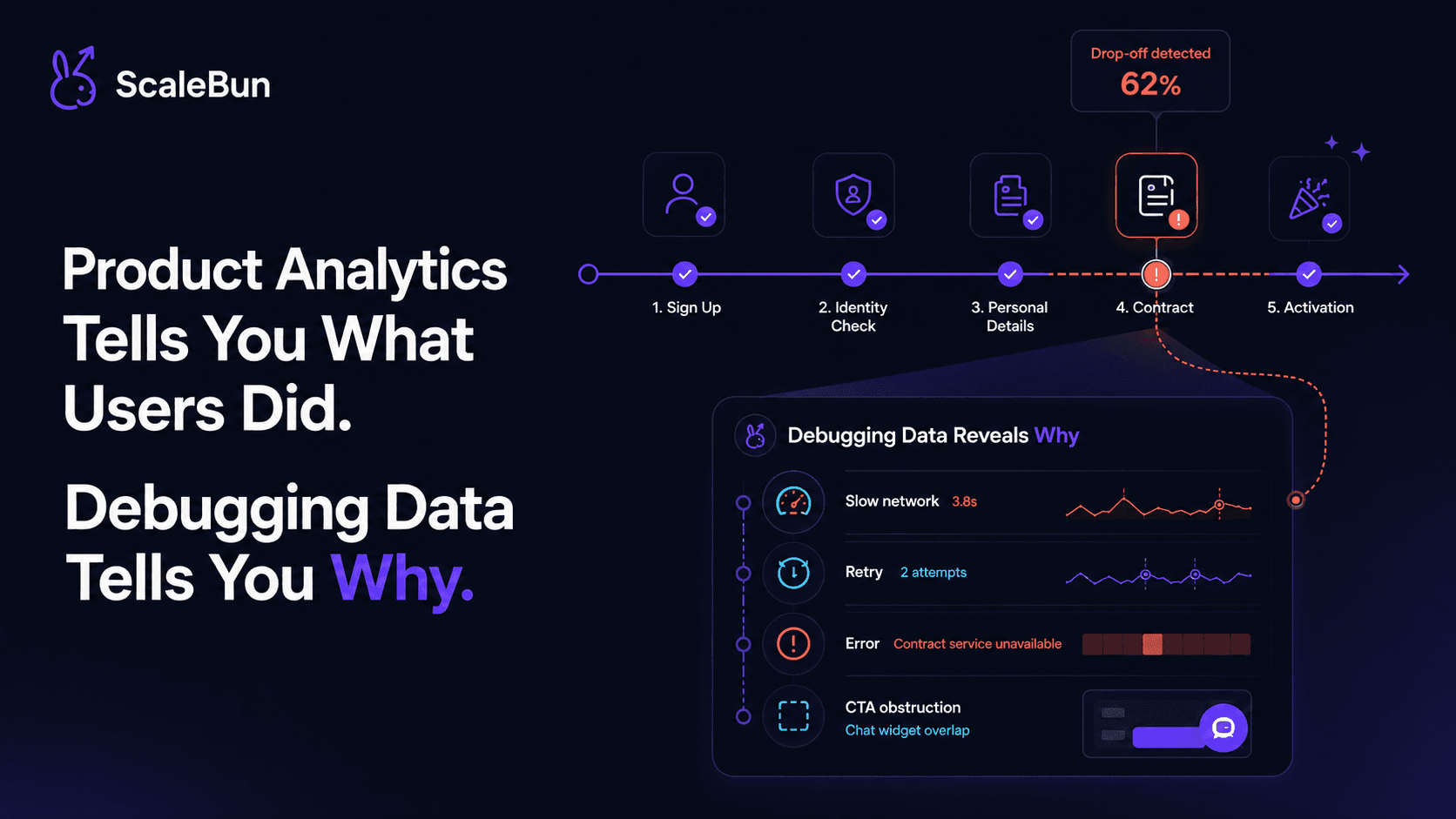
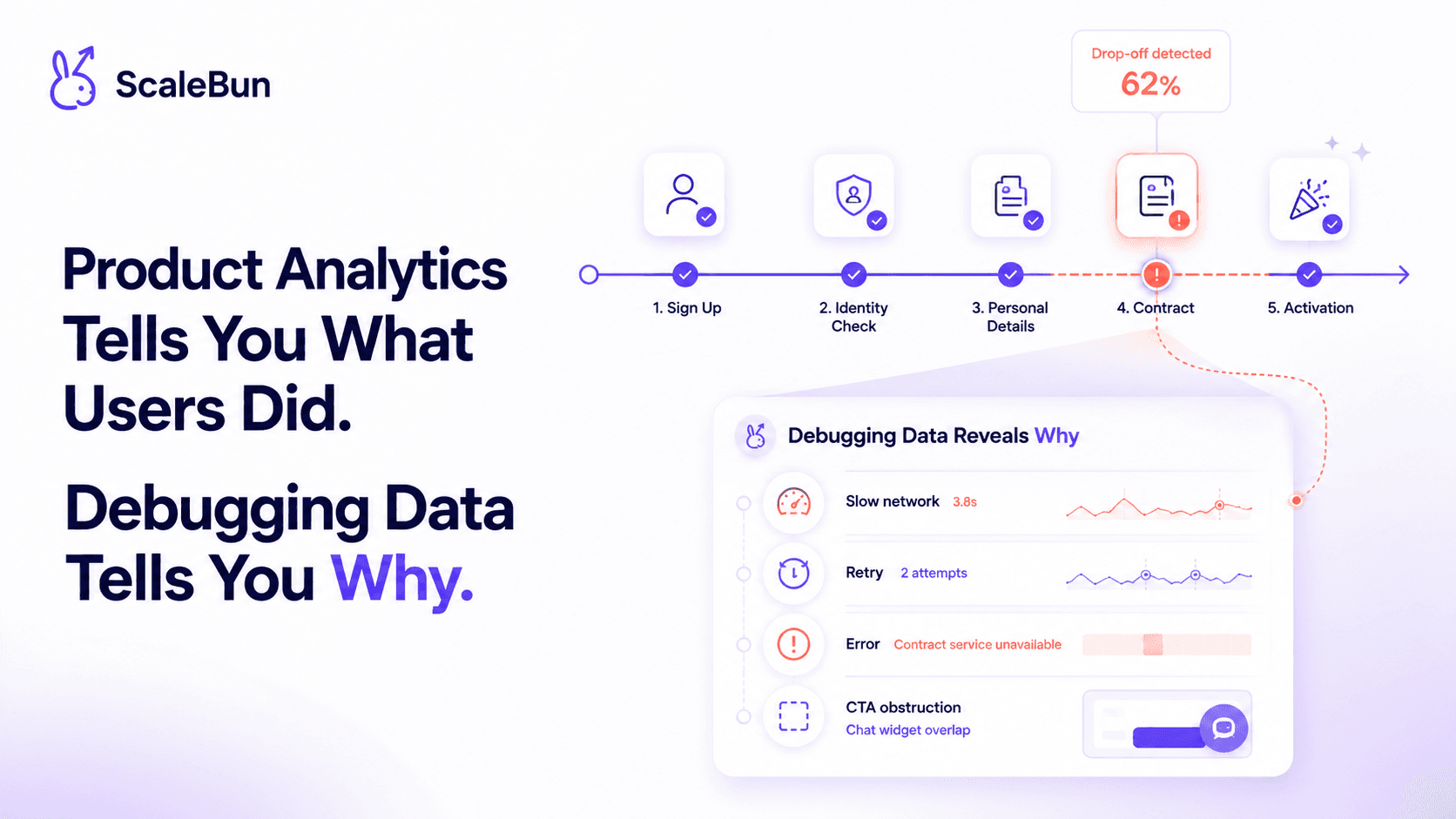
Signup 100%Identity check 82%Personal details 71%Contract 44%Activation 42%There's obviously something happening around the contract stage.
Analytics found the location of the problem.
It did not find the problem.
Maybe users don't understand the screen.
Maybe signing fails on certain devices.
Maybe the API is slow.
Maybe the CTA falls beneath the keyboard.
Maybe there's a JavaScript exception.
Maybe everybody simply hates reading contracts.
All plausible.
The same blind spot shows up in a checkout funnel#
It's not just onboarding. Say a checkout funnel drops off around payment — analytics can tell you the step, but not the cause.
Maybe 300 of them hit a payment API error.
Maybe 180 got a JavaScript exception.
Maybe another 100 had the page sitting there for six seconds before anything happened.
And maybe the rest just changed their mind.
Those are four completely different problems that all look like the same funnel drop if you're only looking at analytics.
Now attach sessions#
This is why connecting analytics with session-level debugging is interesting.
Instead of looking at a 44% conversion rate and guessing, teams can investigate sessions around that event.
You move from:
“Conversion fell.”
to:
“Conversion fell because this request became slower after release X, causing users to retry and abandon.”
That's a completely different level of understanding.
ScaleBun's broader model combines behavioral analytics with session and engineering context.
And that matters because product problems and engineering problems aren't separate universes.
A 500 error can become a conversion problem.
A two-second latency regression can become a revenue problem.
A confusing component can become a support-ticket problem.
The customer experiences one product.
Your organization is the one that divided it into five dashboards.
Connect funnels to the sessions behind them
ScaleBun's product analytics links funnel drop-off to session-level debugging context.
See product analytics→