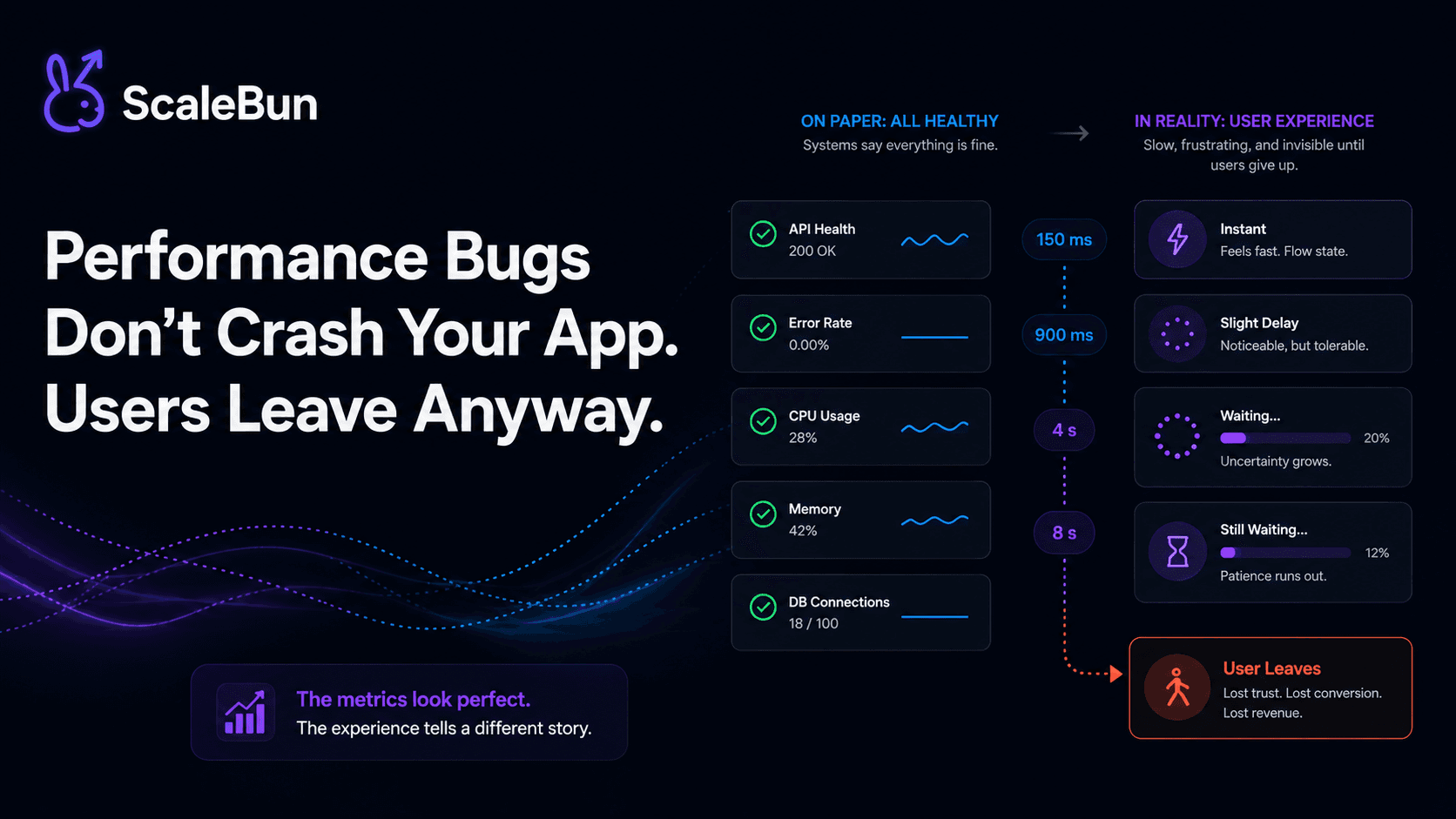
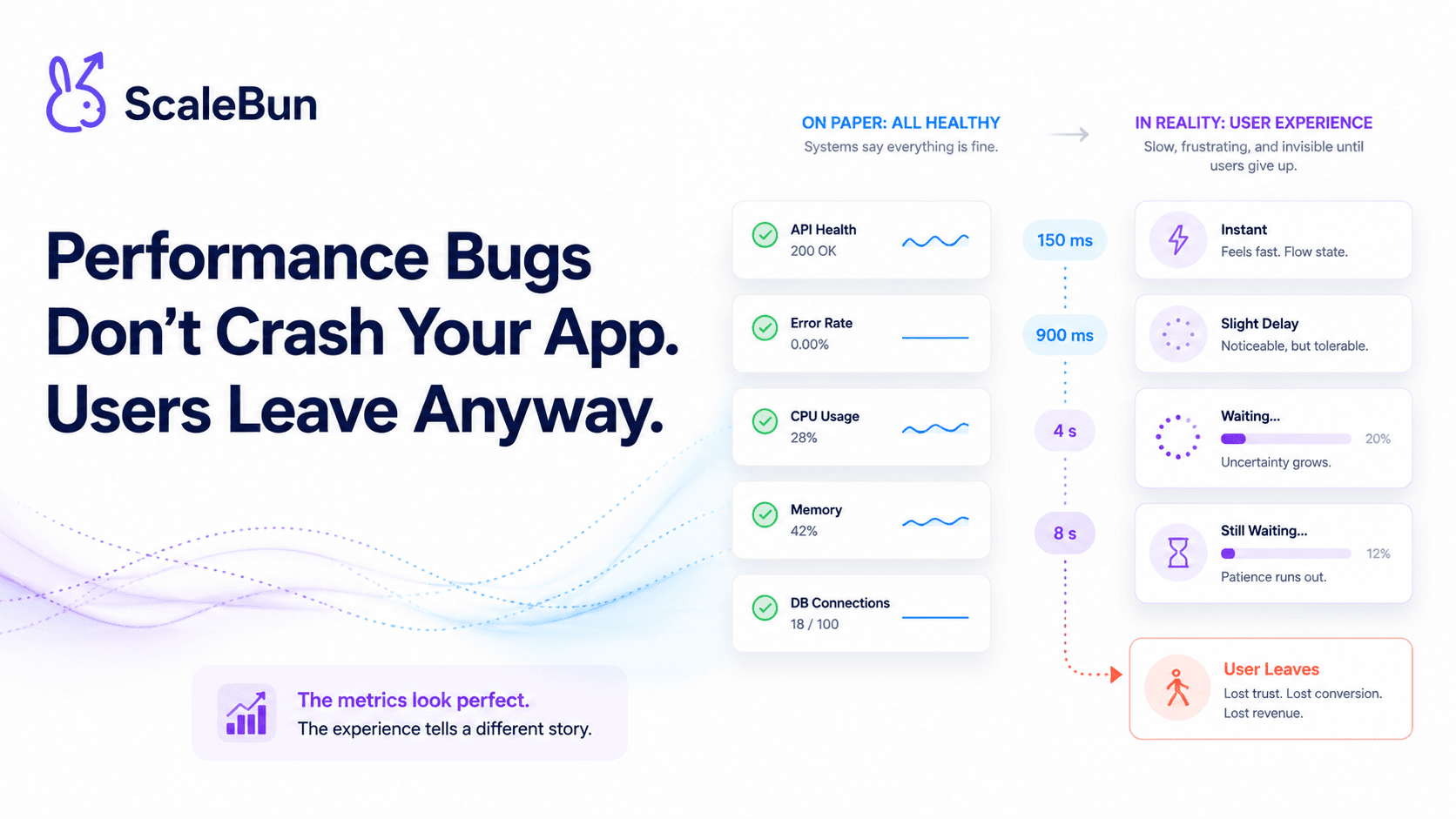
A slow application can be perfectly functional.
No exceptions.
No crashes.
Every request returns HTTP 200.
And users still hate it.
Performance issues are particularly dangerous because traditional error monitoring can report:
Everything looks healthy.while the customer is staring at a spinner contemplating whether they really need your product.
Latency is a product feature#
Take a simple API request.
At 150 ms, interaction feels immediate.
At 900 ms, it feels slightly sluggish.
At four seconds, the user starts wondering whether the click worked.
At eight seconds, they click again.
Now you've created duplicate actions.
Which can create duplicate requests.
Which can create errors.
One latency problem has just mutated into several other problems.
This is why ScaleBun's production debugging model includes performance context around sessions.
Because performance isn't an infrastructure metric sitting somewhere in Grafana.
It's something a human experiences.
And small regressions become huge at scale#
Suppose a new implementation adds 300 ms to a critical path.
Nobody panics.
Three hundred milliseconds sounds tiny.
Now apply it to millions of interactions.
Add:
abandonment
retries
backend work
increased compute
customer frustration
Tiny technical inefficiencies have a remarkable ability to become very expensive business problems.
Engineers often talk about performance using milliseconds.
Businesses eventually experience it as money.
Performance issues, in the same debugging context
ScaleBun ties latency and performance data to the sessions they actually affected.
See performance monitoring→