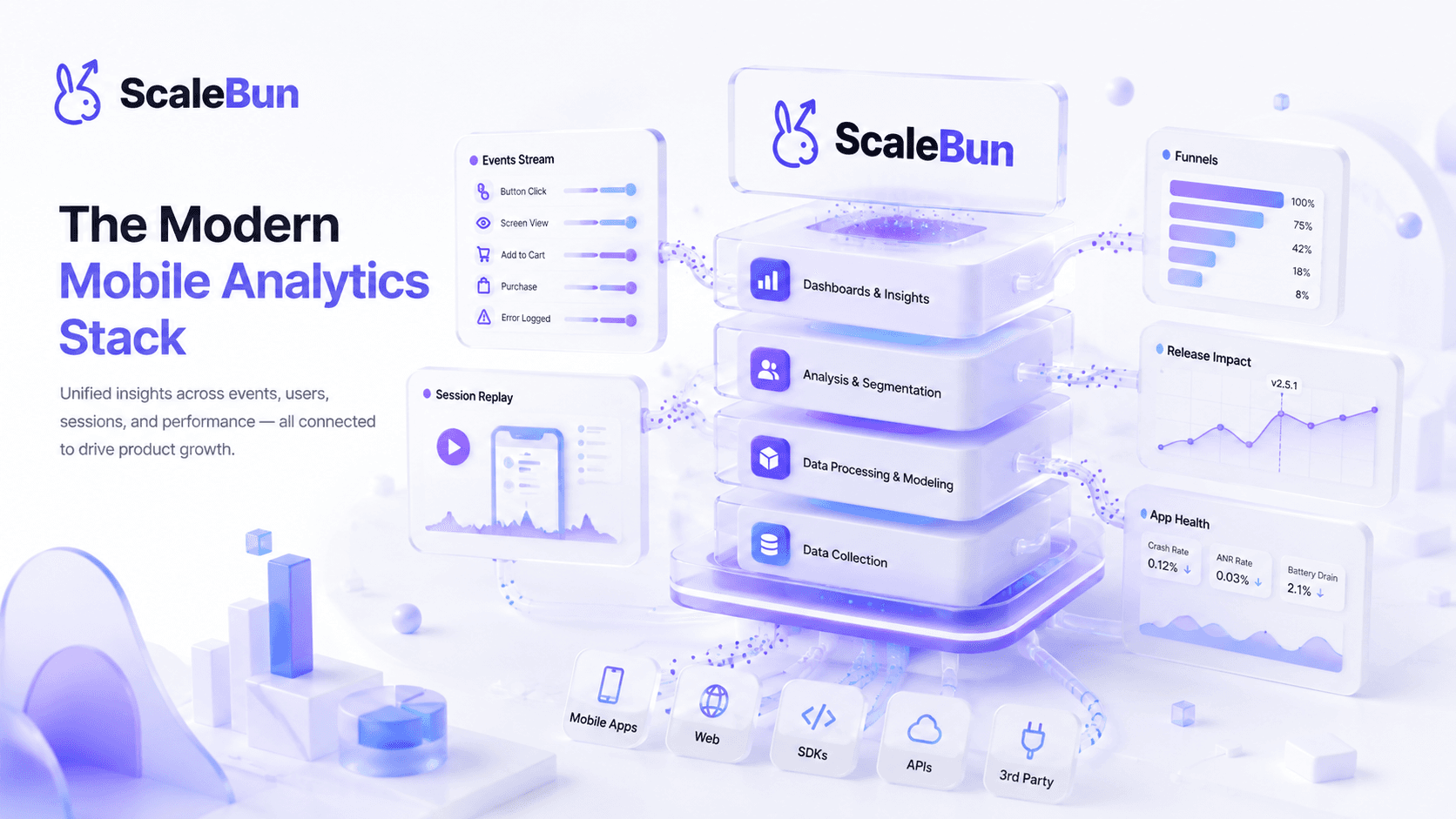
Modern mobile teams rarely use one tool.
They may have one platform for errors, another for analytics, another for attribution, another for engagement, and another for feature management.
Each tool can solve a legitimate problem.
The challenge appears when teams need to answer questions that cross multiple systems.
The Typical Stack#
A mobile organization may use:
Application monitoring#
For:
Crashes
Errors
Release health
Product analytics#
For:
Events
Funnels
Cohorts
Retention
Session replay#
For:
User experience
Bug investigation
Behavioral context
Mobile attribution#
For:
Campaign measurement
Acquisition
Marketing ROI
Engagement#
For:
Push notifications
In-app messages
Lifecycle campaigns
Feature management#
For:
Rollouts
Experiments
Feature exposure
Data warehouse#
For:
Cross-system analysis
Reporting
Historical data
There is nothing inherently wrong with this architecture.
The problem is the join.
The Join Problem#
Suppose a product manager asks:
“Why did users from Campaign X stop converting after Release Y?”
The answer may require:
Attribution data
User identity
Product events
Release information
Error telemetry
Feature exposure
Session context
If each system represents the user differently, someone has to build the bridge.
Identity Fragmentation#
The same person might be represented as:
Advertising identifier
Internal user ID
Analytics ID
Session ID
Device ID
When identity is fragmented, analysis becomes fragile.
Schema Fragmentation#
Different tools also create different event definitions.
One system may call something:
checkout_started
Another:
Checkout Started
Another:
begin_checkout
The more systems involved, the more transformation work is required.
Dashboard Fragmentation#
Even when the data is technically available, teams may spend their time moving between dashboards.
That increases investigation time.
The Connected Alternative#
ScaleBun's philosophy is not:
“Every other tool is bad.”
It is:
“The data becomes more valuable when the context is connected.”
A useful shared model can connect:
User + Session + Application + Release + Feature + Behavior + Acquisition + Outcome
Why This Matters#
Connected data can reduce the distance between teams.
Engineering can understand product impact.
Product can understand technical causes.
Growth can understand product outcomes.
Leadership can understand the full customer journey.
The Cost of Fragmentation#
Fragmentation creates costs beyond subscription fees.
There is also:
Integration maintenance
SDK complexity
Identity synchronization
Data transformation
Dashboard duplication
Training
Debugging time
Warehouse pipelines
The total cost of the stack is therefore larger than the price of each individual tool.
The Future of the Mobile Stack#
The future is unlikely to be “one dashboard for everything.”
A better direction is shared context across specialized signals.
Teams should be able to move from:
Business Metric
to:
User
to:
Session
to:
Application State
to:
Technical Event
without rebuilding the connection every time.
Final Takeaway#
The individual platforms are not necessarily the problem.
The join is.
ScaleBun's strategic opportunity is to make application intelligence more connected so teams can move from signal to context to outcome without constantly rebuilding the bridge between systems.
Explore ScaleBun#
Connect the signals that explain how your application behaves and how users experience it.
Explore ScaleBun →
See the full picture across web and mobile.
Connect application health, user behavior, attribution, and product context with ScaleBun.
Explore ScaleBun →