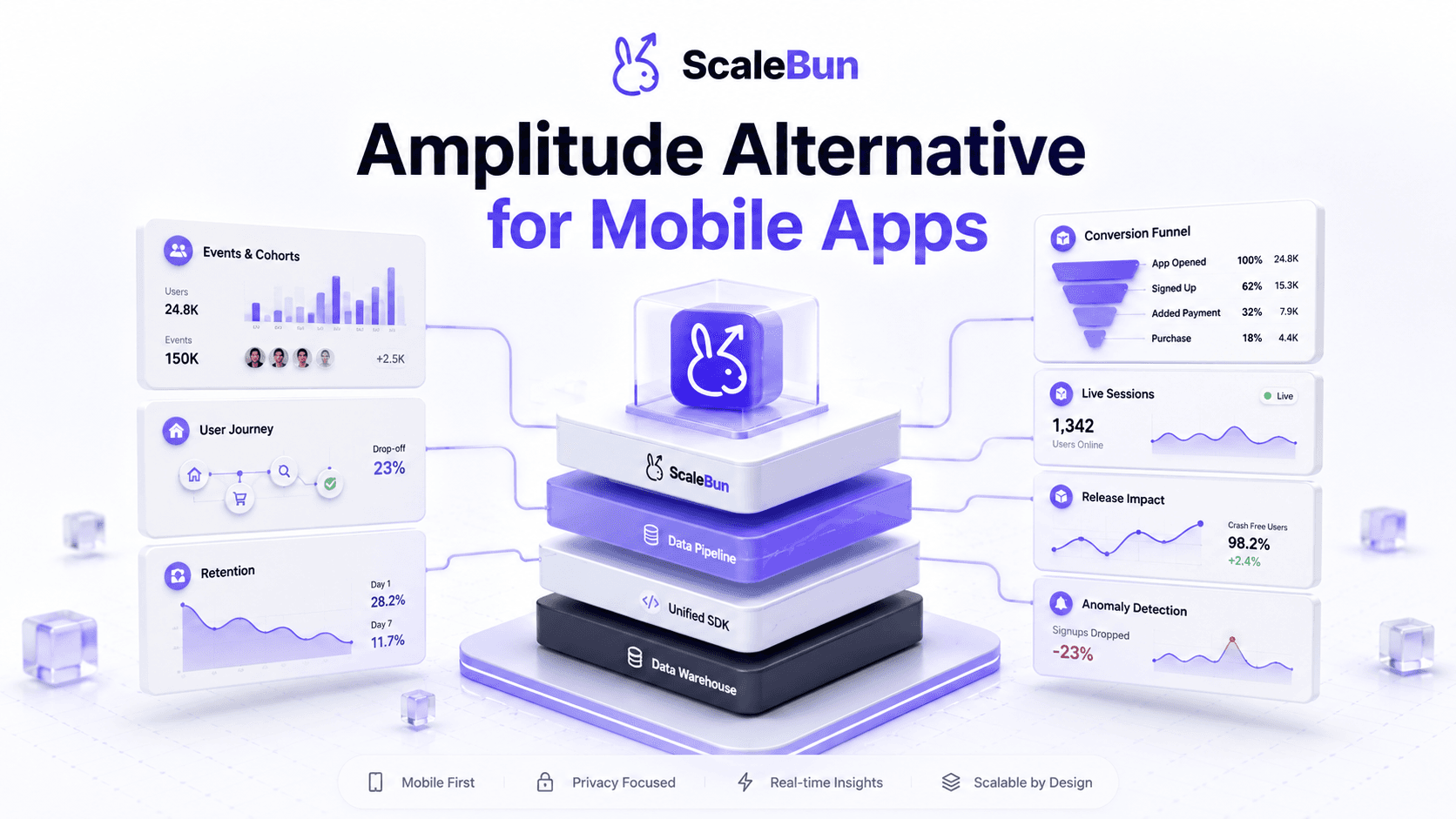
Amplitude Alternative: From Funnel Drop to Root Cause#
Product analytics answers an essential question:
What are users doing?
But when a funnel changes unexpectedly, teams often need to answer another question:
Why did the behavior change?
That is where the boundary between product analytics and application observability becomes important.
Amplitude Is Strong at Product Analytics#
Amplitude is well known for product analytics, funnels, cohorts, experimentation, and behavioral analysis.
The opportunity for a connected platform is not to deny those capabilities.
It is to connect behavioral data with application state.
A Funnel Drop Is a Signal, Not a Diagnosis#
Imagine checkout conversion falls from 60% to 42%.
The funnel tells you:
Checkout Started → Payment → Purchase
and shows where users are leaving.
But a drop-off can have many causes:
Product change
Application release
UI regression
Feature exposure
Technical error
Performance issue
Traffic quality
User cohort difference
A funnel is the beginning of the investigation.
Add Application Context#
A more complete workflow is:
Funnel Drop
→ Affected Cohort
→ Application Version
→ Error Rate
→ Session
→ Feature Exposure
→ Acquisition Source
→ Conversion
Now the product team can ask whether the regression is behavioral, technical, or both.
Cohorts Become More Powerful With Technical Context#
A cohort such as “users who abandoned checkout” becomes more actionable when it can be analyzed by:
App version
Platform
Feature configuration
Error occurrence
Session behavior
Acquisition source
The goal is not simply to create more segments.
It is to make existing segments more informative.
Product Analytics Meets Session Context#
A funnel tells you where users leave.
A session can help explain what happened before they left.
This is especially valuable for:
Onboarding
Checkout
Search
Forms
Subscription flows
Complex navigation
Feature Exposure Can Explain Behavioral Changes#
Suppose only users exposed to a new checkout experience show the regression.
Without feature context, the team may see a generic funnel decline.
With feature context:
Funnel Drop → Feature Exposure → Session → Error
The hypothesis becomes much easier to test.
Application Releases Matter#
Behavior changes after releases are common.
If a funnel regression begins immediately after a new version, teams should be able to connect:
Product Metric → Release → Application Health
That reduces the gap between product analytics and engineering investigation.
Why Consider an Amplitude Alternative?#
The right alternative depends on the team's needs.
For teams that want deeper connections between product behavior and application health, ScaleBun's approach is to make these signals part of the same application context.
The value is not another funnel chart.
The value is the path from the funnel to the underlying experience.
ScaleBun's Connected Model#
A typical investigation can look like:
Funnel
→ Cohort
→ Session
→ Release
→ Error
→ Feature
→ Attribution
→ Outcome
This is the broader application intelligence model ScaleBun is designed around.
Final Takeaway#
Product analytics is most useful when it helps teams make decisions.
When a metric moves, teams need context.
The ideal workflow turns:
“The funnel dropped.”
into:
“These users dropped, after this change, in this application state, during this experience, and here is what happened.”
Explore ScaleBun#
Connect product behavior with application health and user experience.
Explore ScaleBun →
See the full picture across web and mobile.
Connect application health, user behavior, attribution, and product context with ScaleBun.
Explore ScaleBun →