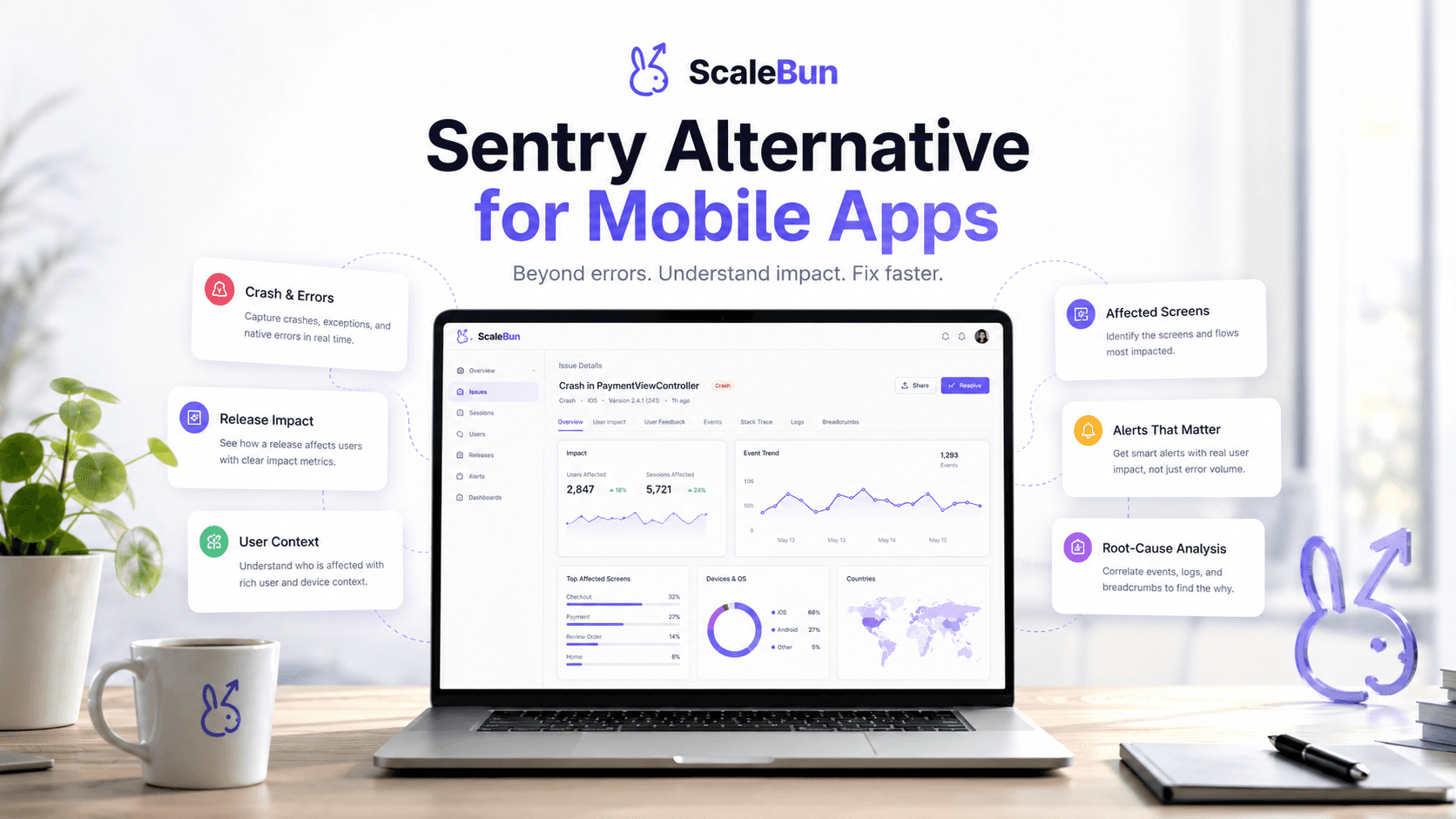
Sentry Alternative for Mobile Apps: From Error to Product Context#
Sentry is widely used for application error monitoring and observability.
For teams evaluating alternatives, the useful question is not simply:
“Which tool has more error-monitoring features?”
A better question is:
“How much context do we have when an error happens?”
A production error is rarely valuable in isolation.
The engineering team may need to know:
Who experienced it?
What were they doing?
Which release were they running?
Which feature configuration did they receive?
Where did they come from?
Did they convert?
Did they abandon the session?
This is where ScaleBun takes a different approach.
Error Monitoring Is Only the Starting Point#
A stack trace can identify the technical location of a failure.
But an application failure exists inside a user journey.
Consider:
Checkout Error
That event becomes more useful when connected to:
Checkout Error → User → Session → Screen → Action → Release → Feature → Acquisition → Outcome
The additional context can change how a team prioritizes the issue.
Sentry Is Strong at Error Monitoring#
A fair comparison starts by acknowledging what the incumbent does well.
Sentry provides application monitoring capabilities designed to help developers identify, investigate, and resolve errors.
The question for ScaleBun is different:
Can the error become the entry point into a broader application intelligence workflow?
From Stack Trace to Session#
Suppose a checkout error increases after a new release.
An engineer can identify the error.
The next questions are harder:
Did users get stuck before payment?
Did they retry?
Did they navigate away?
Did they come from a specific campaign?
Were they exposed to a particular feature?
Is the issue isolated to a cohort?
Connecting technical events with session context makes those questions easier to investigate.
The Release Dimension#
Errors are often release-dependent.
A useful investigation therefore includes:
Error → Release → Affected Users
This allows teams to distinguish between:
Long-standing issues
New regressions
Release-specific problems
Feature-specific problems
The Feature Dimension#
Application version is not always enough.
Feature flags, experiments, and staged rollouts can create multiple application experiences inside the same release.
That creates another useful dimension:
Release + Feature Exposure + Error
This can make a regression much easier to isolate.
The Product Dimension#
The most important error is not always the most frequent one.
A low-volume error during a high-value conversion flow may deserve more attention than a high-volume error on a low-impact screen.
Connecting errors to product outcomes gives engineering and product teams more context for prioritization.
The Growth Dimension#
Acquisition source can also matter.
If users from one campaign experience a higher failure rate during onboarding, the team can investigate both:
Marketing quality
Application experience
That creates a broader chain:
Campaign → User → Session → Error → Conversion
Why Teams Consider a Broader Sentry Alternative#
The goal should not be to replace good error monitoring with more dashboards.
The goal is to reduce the number of disconnected systems needed to answer one question.
ScaleBun's positioning is:
Start with the error, then follow the context.
ScaleBun's Connected Investigation Model#
A ScaleBun investigation can be conceptually represented as:
Error
→ User
→ Session
→ Replay
→ Release
→ Feature
→ Attribution
→ Product Outcome
The value is in the connections.
Who Should Consider This Approach?#
A connected model is especially useful for teams where:
Engineering owns application health
Product owns funnels and feature adoption
Growth owns acquisition
Teams frequently need to correlate data across these functions
Final Takeaway#
Choosing a Sentry alternative should not be about finding a longer feature checklist.
It should be about finding the shortest path from:
“Something failed.”
to:
“We know who experienced it, what they were doing, what changed, and what happened afterward.”
Explore ScaleBun#
Connect application health with user behavior, sessions, releases, attribution, and product context.
Explore ScaleBun →
See the full picture across web and mobile.
Connect application health, user behavior, attribution, and product context with ScaleBun.
Explore ScaleBun →