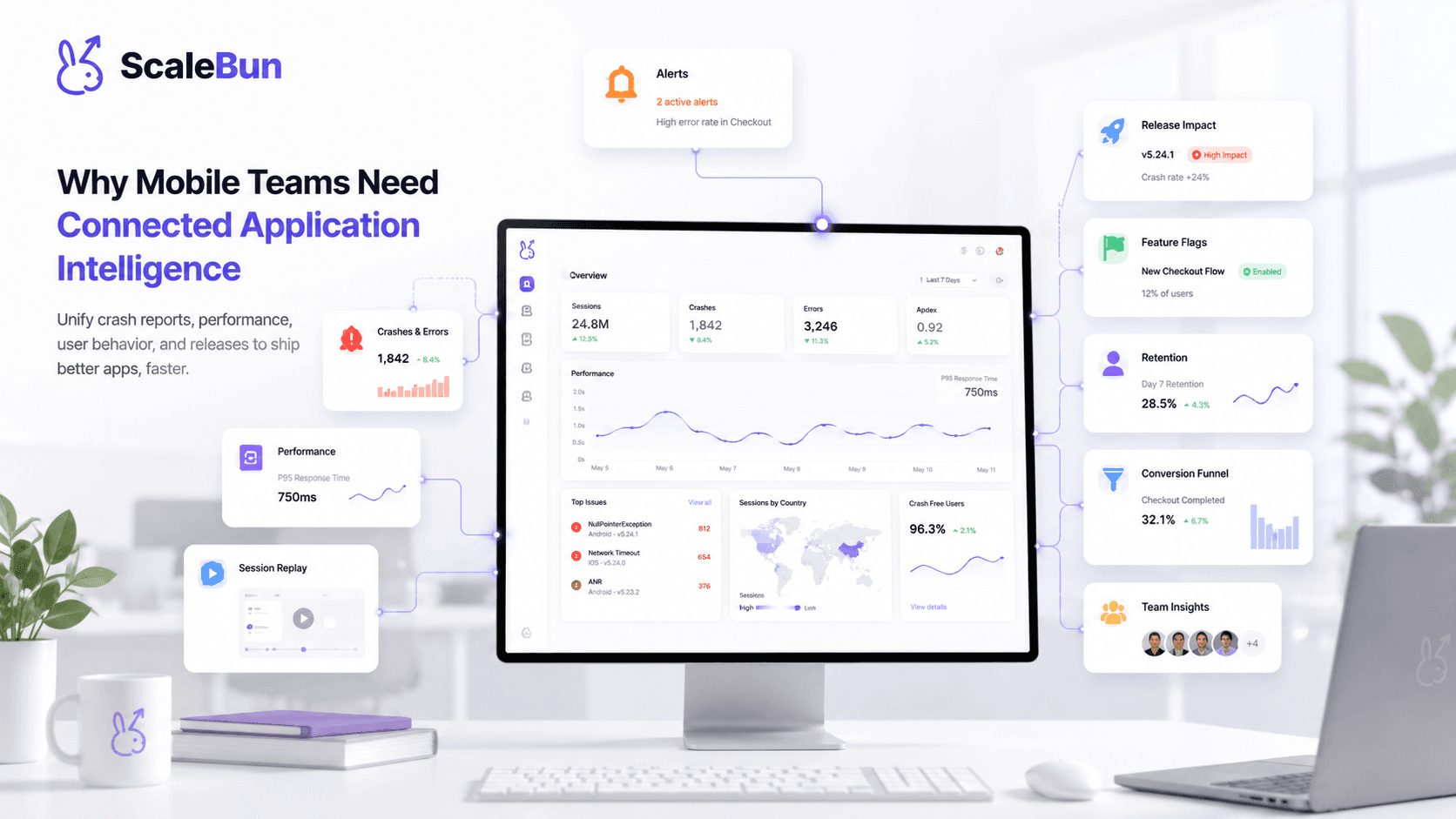
Mobile applications are no longer measured through one dimension.
Engineering cares about stability.
Product cares about behavior.
Growth cares about acquisition.
Marketing cares about campaigns.
Leadership cares about outcomes.
The user experiences all of these things as one application.
That creates a strategic problem:
Why should the data describing that experience live in completely disconnected systems?
The Application Is One System#
A user does not think:
“I am now inside the analytics layer.”
or:
“I have moved from the attribution system to the error-monitoring system.”
They simply use the application.
Their experience produces multiple signals:
User
Session
Application
Release
Feature
Behavior
Acquisition
Outcome
Those signals describe one journey.
What Is Connected Application Intelligence?#
Connected application intelligence is the idea that application signals become more useful when they share common context.
Instead of analyzing:
Crashes
Product events
Sessions
Attribution
Features
Engagement
as independent datasets, teams can connect them around the same application, user, session, and release context.
The Identity Model Is the Foundation#
The most important question is:
Can these systems agree on who and what they are describing?
A shared identity model can connect:
User → Session → Application → Release → Feature → Event → Outcome
Without that foundation, every cross-functional question becomes an integration problem.
The Same Event Can Matter to Different Teams#
Consider a checkout error.
Engineering sees:
Checkout error increased
Product sees:
Checkout conversion decreased
Growth sees:
Campaign conversion decreased
Leadership sees:
Revenue declined
These may all be the same event chain.
Connected intelligence makes that relationship visible.
From Monitoring to Understanding#
Traditional monitoring often asks:
Is the system healthy?
Product analytics asks:
Are users doing what we expect?
Marketing analytics asks:
Where did users come from?
Connected application intelligence asks:
How are these things related?
That is the strategic shift.
A Connected Investigation#
Imagine conversion declines.
The investigation can follow:
Conversion Drop
↓
Affected Users
↓
Sessions
↓
Application Version
↓
Feature Exposure
↓
Errors
↓
Acquisition Source
↓
Retention
Each step adds context.
Why This Is a Product Advantage#
The moat is not necessarily having another dashboard.
It is reducing the amount of work required to connect information.
A team that can answer a complex question in minutes instead of assembling data from six systems has a real operational advantage.
Why This Matters for Engineering#
Engineering can prioritize issues using:
User impact
Revenue impact
Feature impact
Release impact
Session context
That is more useful than ranking errors only by raw frequency.
Why This Matters for Product#
Product teams can connect:
Funnel changes
Feature exposure
User cohorts
Sessions
Technical issues
This creates stronger evidence for product decisions.
Why This Matters for Growth#
Growth teams can move from:
Campaign → Install
to:
Campaign → User → Product Experience → Conversion → Retention
That is a more complete view of acquisition quality.
The ScaleBun Philosophy#
ScaleBun is built around a simple idea:
The moat isn't more buttons. The moat is connecting different categories of application intelligence under the same identity model.
The value comes from the relationships between signals.
The Future of Application Intelligence#
As applications become more complex, teams will generate more telemetry, not less.
The challenge will not be collecting enough data.
The challenge will be understanding it.
The winning platforms will help teams answer:
What happened?
Who experienced it?
What changed?
What were they doing?
Which version were they using?
Which feature did they receive?
Where did they come from?
What happened afterward?
Final Takeaway#
A modern application is one experience.
Its intelligence should be connected accordingly.
User + Session + Application + Release + Feature + Behavior + Acquisition + Outcome
That is the foundation of connected application intelligence.
Explore ScaleBun#
See the full picture of your mobile application.
Explore ScaleBun →
PART 3 — CONTENT CLUSTER / INTERNAL LINK MAP#
Use this map when adding contextual internal links.
Pillar#
Mobile App Observability
→ Sentry Alternative
→ Amplitude Alternative
→ React Native Monitoring
→ Mobile Session Replay
→ Mobile Analytics Stack
→ Connected Application Intelligence
Comparisons#
Sentry Alternative
→ Mobile App Observability
→ React Native Monitoring
→ Mobile Session Replay
→ Connected Application Intelligence
Amplitude Alternative
→ Mobile App Observability
→ Mobile Session Replay
→ Mobile Analytics Stack
→ Connected Application Intelligence
AppsFlyer Alternative
→ Mobile Attribution
→ Mobile Analytics Stack
→ Connected Application Intelligence
Adjust Alternative
→ Mobile Attribution
→ Mobile Analytics Stack
→ Connected Application Intelligence
Singular Alternative
→ Mobile Attribution
→ Mobile Analytics Stack
→ Connected Application Intelligence
MoEngage Alternative
→ Mobile App Observability
→ Mobile Session Replay
→ Connected Application Intelligence
Educational#
React Native Monitoring
→ Mobile App Observability
→ Mobile Session Replay
→ Sentry Alternative
Mobile Session Replay
→ Mobile App Observability
→ React Native Monitoring
→ Amplitude Alternative
Mobile Attribution
→ AppsFlyer Alternative
→ Adjust Alternative
→ Singular Alternative
→ Mobile Analytics Stack
Mobile Analytics Stack
→ Mobile App Observability
→ Mobile Attribution
→ Connected Application Intelligence
Connected Application Intelligence
→ Mobile App Observability
→ Mobile Analytics Stack
→ All comparison articles
PART 4 — FINAL IMPLEMENTATION RULES#
Do not invent competitor weaknesses.
Do not invent ScaleBun capabilities.
Preserve the factual meaning of these articles.
Improve grammar/formatting when adapting them to the UI.
Keep SEO keywords natural.
Avoid keyword stuffing.
Use internal links strategically.
Keep competitor articles educational and commercially useful.
Make the Blog section feel like a real ScaleBun publication.
Do not break the existing website.
Core ScaleBun positioning#
ScaleBun connects the data that modern mobile teams otherwise have to stitch together.
The blog should consistently reinforce this idea without repeating the exact sentence unnaturally.
See the full picture across web and mobile.
Connect application health, user behavior, attribution, and product context with ScaleBun.
Explore ScaleBun →