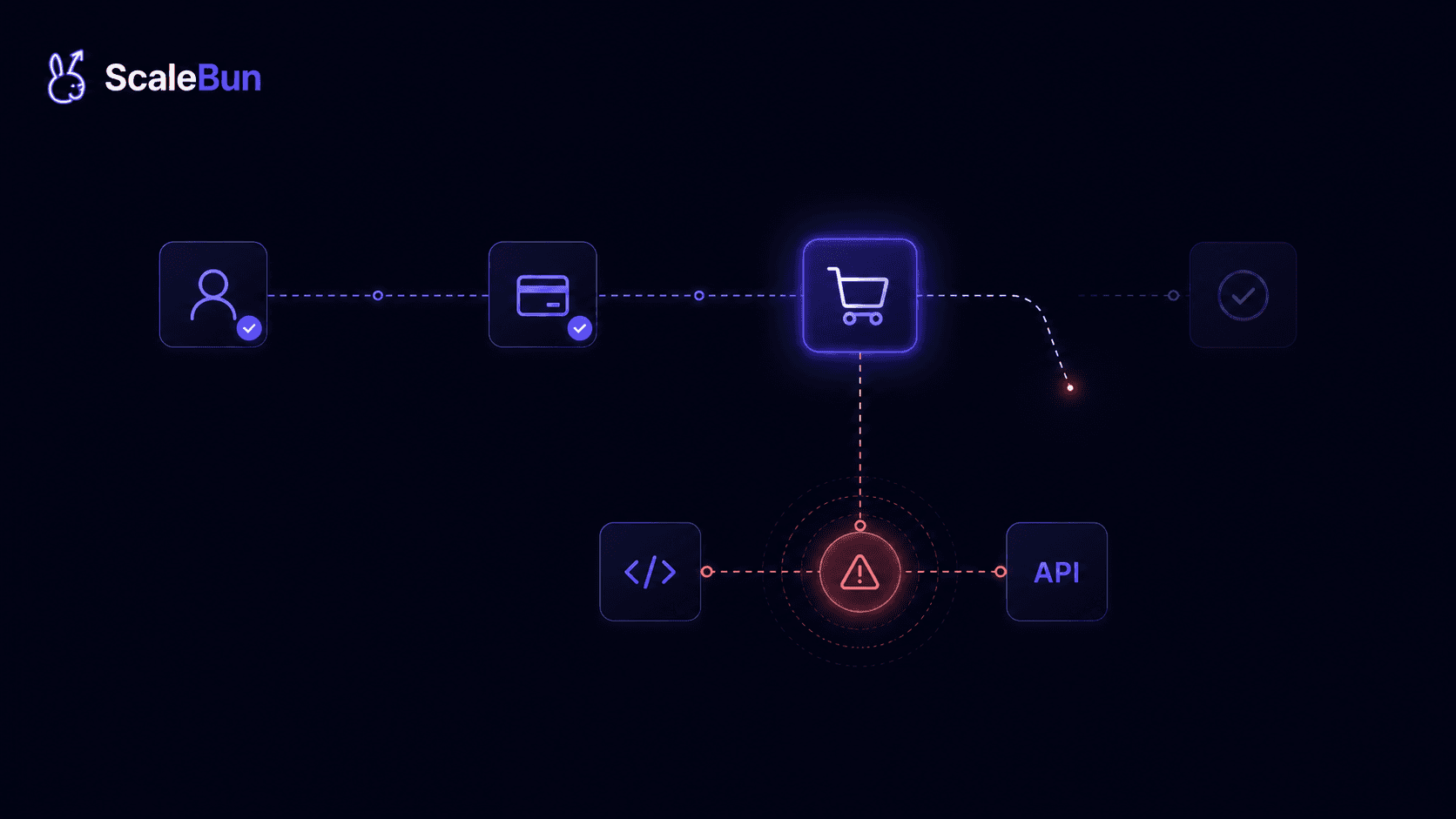
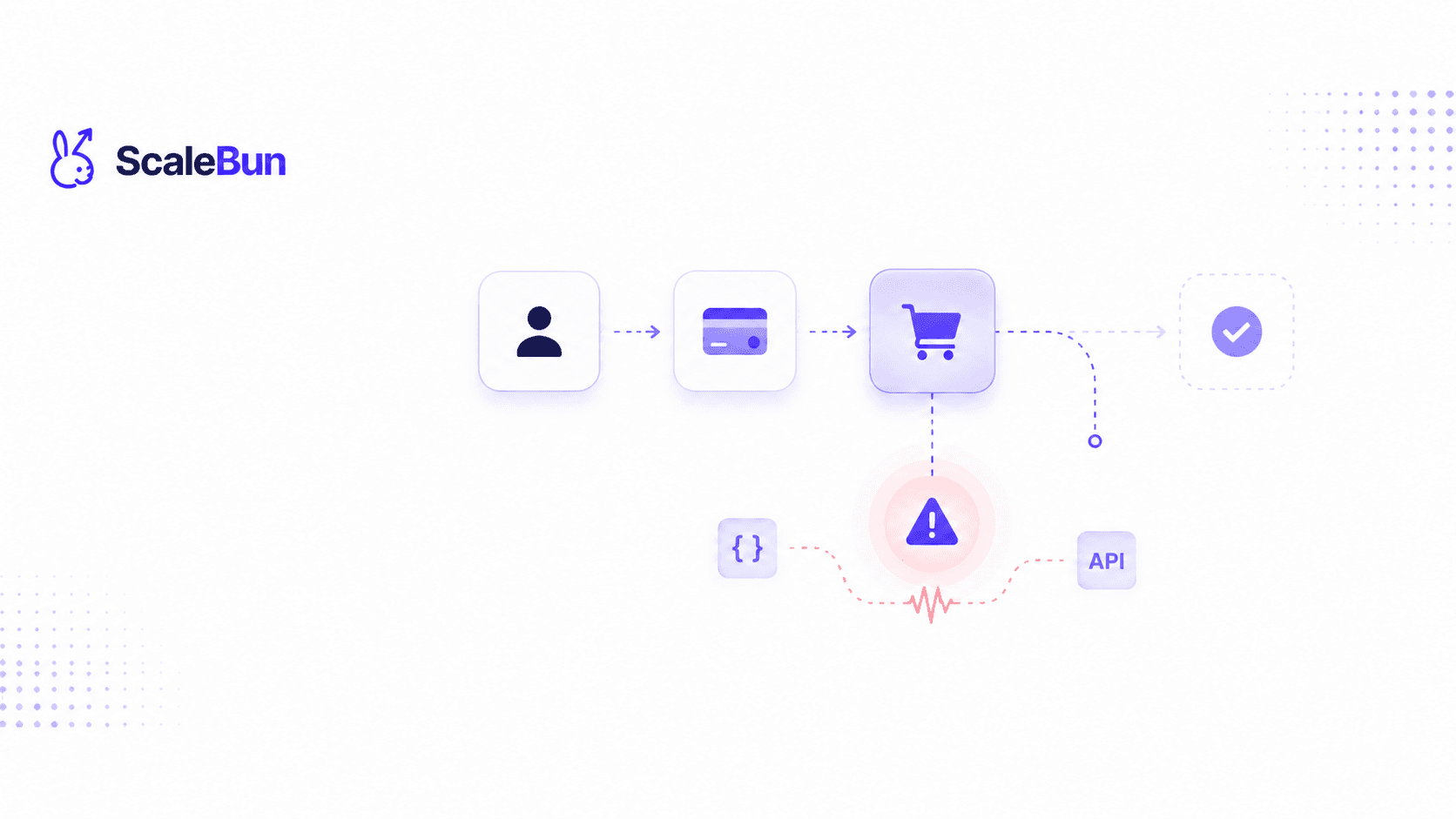
A conversion drop usually turns into a product conversation first.
Someone sees checkout down 12%.
Then everyone starts asking the obvious stuff.
Did we change the copy?
Did we move the button?
Did traffic quality change?
Did the new flow confuse people?
Sometimes that's the right direction.
Sometimes the button is fine and the API behind it is throwing 500s.
That's the part I think gets missed when product analytics and technical monitoring live completely separate lives.
Say your funnel looks normal until the last step.
10,000 people hit checkout.
6,400 make it to payment.
Only 4,900 finish.
So you've got 1,500 people disappearing somewhere around payment.
Analytics tells you that.
Cool.
But now you still have to figure out why.
Maybe 300 of them hit a payment API error.
Maybe 180 got a JavaScript exception.
Maybe another 100 had the page sitting there for six seconds before anything happened.
And maybe the rest just changed their mind.
Those are four completely different problems.
They all look like the same funnel drop if you're only looking at analytics.
I'd rather click that drop-off and immediately see what was happening inside those sessions.
Not every session. Just the ones that actually failed.
Something like:
1,500 users dropped.
312 hit an API error.
176 had a frontend exception.
94 had really slow responses.
61 rage-clicked the payment button.
The rest didn't show an obvious technical issue.
Now I'm not guessing anymore.
If I click the 176 frontend errors, show me which errors they were.
Then let me open one and watch the session.
That's a way more useful path than bouncing from analytics to error monitoring to replay and hoping all the IDs match.
I don't think analytics is bad at explaining why people leave.
It's just not really its job.
It tells you where the problem is.
The technical side usually tells you why it happened.
Those two things should probably be closer together than they are today.
See the full picture across web and mobile.
Connect application health, user behavior, attribution, and product context with ScaleBun.
Explore ScaleBun →